


In Calgary’s climate, what happens in your attic shortens or extends the life of your roof, and quietly drives your heating bill. Here is how R-value, air sealing, and ventilation tie it all together.
Most homeowners think of the roof and the attic as separate things: one is shingles, the other is the dusty space you only visit to find Christmas decorations. In reality they are one system, and the condition of the attic directly determines how long the roof above it survives. In Calgary’s climate, getting the attic wrong is one of the fastest ways to cook a roof from underneath.
The link runs through three connected factors: insulation R-value, air sealing, and ventilation. Get them right and the roof lasts its full life while your heating bill stays in check. Get them wrong and you invite ice dams, condensation, premature shingle aging, and a winter ENMAX bill that climbs every year. This guide explains how the pieces fit together and what to do about them.
Why the attic decides the roof’s fate
A shingle is designed to be heated by the sun from above and cooled by ventilated air from below. When an attic traps heat and moisture, the underside of the roof deck stays warm and damp, and the shingles age faster than they should. Manufacturers know this, which is why inadequate ventilation is one of the most common reasons a roof warranty claim gets denied.
In winter, the problem flips but stays just as damaging. Warm, moist air leaking up from the house into a cold attic condenses on the underside of the deck, soaking the wood and the insulation. Over years, that moisture rots decking and breeds mould, and the homeowner never sees it until a re-roof exposes the damage. The attic is where roofs quietly die.
R-value: how much insulation Calgary homes need
R-value measures how well insulation resists heat flow, and higher is better. Calgary’s long, cold winters call for a well-insulated attic, and current building-code expectations for our climate zone land in the high R-values, often in the R-50 to R-60 range for attics. Many older Calgary homes were built to a much lower standard and have been quietly under-insulated for decades.
Under-insulation costs you twice. It drives up heating bills as warm air escapes through the ceiling, and it contributes to the temperature differences that create ice dams. Topping up attic insulation is one of the higher-return upgrades available to a Calgary homeowner, and it pairs naturally with a re-roof when the attic is already being accessed.
More insulation alone is not the whole answer, though. Piling insulation over a leaky, poorly ventilated attic can trap moisture and make things worse. Insulation works only when air sealing and ventilation are handled alongside it.
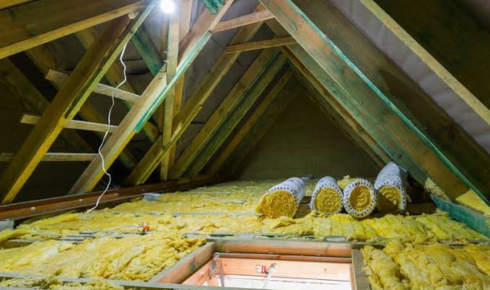
Checking your own attic is straightforward. On a dry day, climb up with a flashlight and look at the depth of the insulation across the floor of the attic. If you can see the tops of the ceiling joists poking through, you are almost certainly under-insulated, because adequate coverage for our climate buries them well. Thin, uneven, or compressed insulation, and bare patches near the eaves, all point to a top-up being overdue. It is one of the few home upgrades you can roughly assess yourself in five minutes.
Air sealing: the step that gets skipped
Air sealing means closing the gaps where warm, moist household air sneaks into the attic: around light fixtures, the attic hatch, plumbing stacks, bathroom fans, and the top plates of interior walls. This is the least glamorous part of attic work and the most commonly skipped, yet it matters enormously in Calgary.
Here is why. Every cubic metre of warm indoor air that leaks into a cold attic carries moisture. When it hits the cold roof deck, that moisture condenses, frosts, and then drips as it melts. Homeowners sometimes mistake this for a roof leak when the real source is interior air escaping upward. Sealing those gaps before adding insulation is what keeps the attic dry and the deck sound.
Air sealing also stops the warm air that feeds ice dams. A tight ceiling plane keeps heat in the house where you paid to put it, rather than letting it warm the roof and start the freeze-thaw cycle that drives water under your shingles. Done before an insulation top-up, it is one of the highest-value hours a contractor can spend in a Calgary attic.
Ventilation and the Calgary ice-dam problem
Ventilation keeps the attic cold and dry by moving outside air through it: intake low at the soffits, exhaust high at the ridge. The goal is to keep the roof deck close to the outdoor temperature so snow on the roof melts evenly rather than refreezing at the cold eaves.
Ice dams form when heat escaping into the attic melts snow on the upper roof, the meltwater runs down to the cold overhang, and it refreezes into a ridge of ice. That dam then backs water up under the shingles and into the house. Calgary’s Chinooks make this worse, because the rapid warm-cold swings repeatedly melt and refreeze the snowpack on the roof.
The fix is the trio working together: insulation to slow heat loss, air sealing to stop warm air leaks, and ventilation to keep the deck cold. Tackle only one and the problem usually persists. The signs of trouble are worth knowing:
- Thick ice buildup or large icicles along the eaves in winter.
- Frost or water staining on the underside of the roof deck.
- Damp, compressed, or matted insulation, especially near the eaves.
- Rising winter heating bills with no change in habits.
- Mould or a musty smell in the attic space.
What it costs to ignore the attic
The price of neglecting attic work is paid in three currencies, and they add up quietly over years. The first is energy. An under-insulated, leaky attic lets heat pour out through the ceiling all winter, and in a Calgary climate of long, cold months that shows up as a heating bill that runs higher than it should every single year. The waste is invisible, which is exactly why it goes unaddressed.
The second currency is the roof itself. A roof installed over a hot, damp, poorly vented attic ages from below, and shingles that should last 25 years can give out years early. Replacing a roof a decade ahead of schedule is one of the most expensive consequences of a problem that lives in a space most homeowners never enter.
The third is the building structure. Persistent condensation rots decking, soaks insulation, and feeds mould inside the attic, and that damage compounds silently until a re-roof or a renovation finally exposes it. By then the repair is no longer a tune-up; it is a rebuild. The attic is cheap to fix and expensive to ignore, and the gap between those two numbers only widens with time.
Timing the work with a re-roof
The most cost-effective moment to fix attic problems is when the roof is being replaced anyway. The crew is already on site, the roof can be properly vented as part of the install, and any decking damaged by past condensation gets caught and replaced rather than buried under new shingles.
Treating the re-roof and the attic as one project also protects your new warranty. A fresh roof installed over an under-ventilated attic starts aging the day it goes on, and a future warranty claim can be denied on those grounds. Doing the attic right at the same time is how you get the full lifespan you paid for.
Fix the attic, save the roof
The roof you can see is only half the system. The insulation, air sealing, and ventilation you cannot see decide whether that roof reaches its full lifespan or fails a decade early, and they show up every month on your heating bill. In Calgary’s climate of deep cold and whiplash Chinooks, the attic is not an afterthought. It is the foundation the roof depends on.
If your home shows ice dams, a rising winter bill, or a musty attic, those are signals worth investigating before your next re-roof. A trusted Calgary roofing team can assess the attic and the roof together and tell you honestly which fixes will actually move the needle. Treat them as one system, and both the roof and your wallet last longer.
About the author — this article was contributed by Angel’s Roofing, a Calgary residential roofing contractor that assesses attic ventilation and insulation as part of every roof evaluation. The company holds COR certification and keeps a full-time safety coordinator on staff for work at height.