Category: Finance

  • Why Crypto Traders Obsess Over a Single “Fear and Greed” Number

    Why Crypto Traders Obsess Over a Single “Fear and Greed” Number

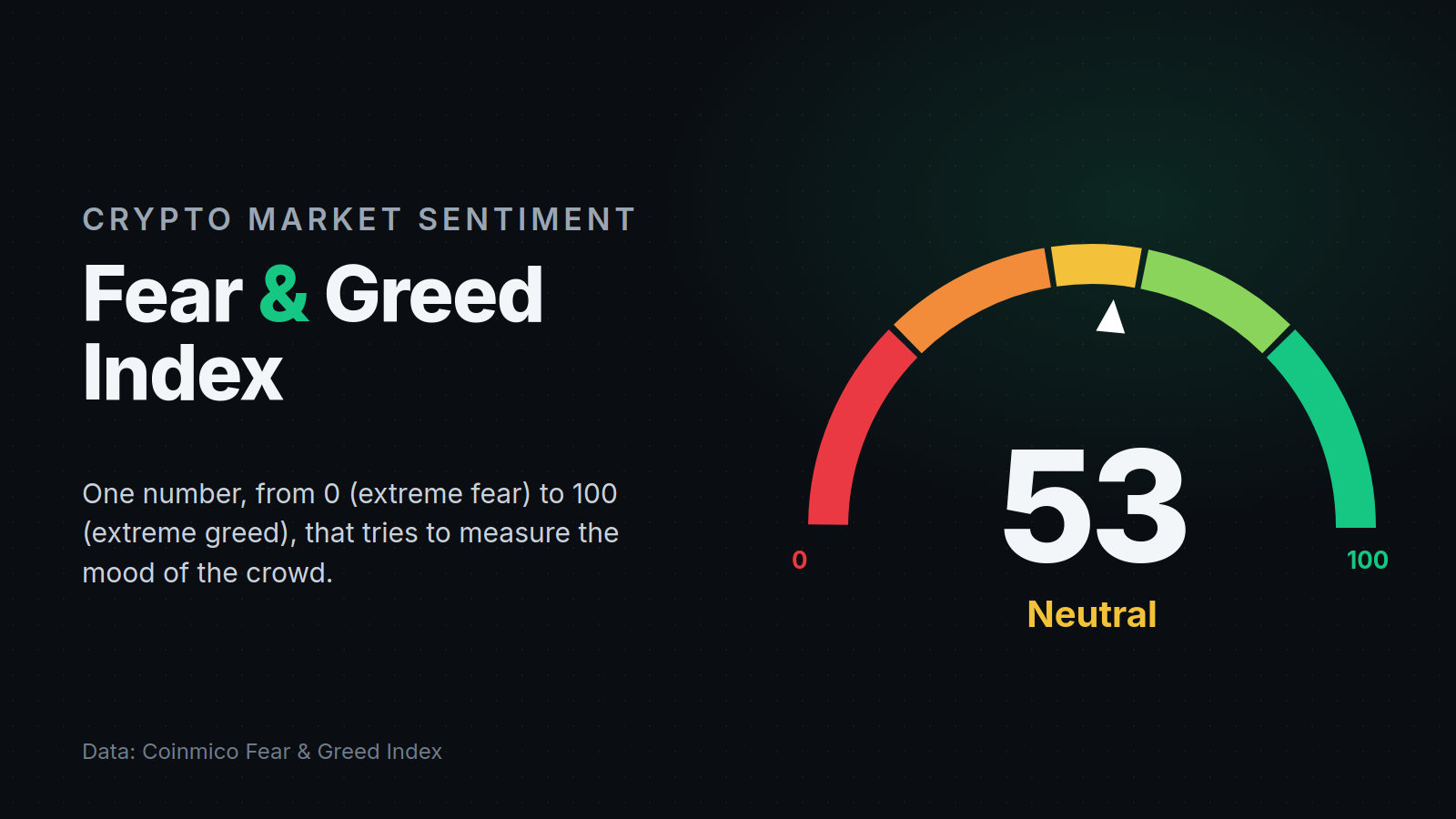
    Spend ten minutes in any crypto group chat and someone will eventually post a screenshot of a speedometer-style gauge with a number on it. “Extreme fear, 18.” “Greed, 71.” No price, no coin name, just the number. For newcomers it looks like a horoscope. For many traders it is the first thing they check in the morning.

    The idea is older than crypto. CNN introduced a Fear & Greed Index for the stock market years ago, based on the simple observation that markets are moved by people, and people swing between panic and overconfidence. When everyone is terrified, assets tend to be cheaper than they should be. When everyone is euphoric, the opposite. The index tries to put a number on that mood: 0 means extreme fear, 100 means extreme greed.

    In crypto the swings are more violent, so the gauge became even more popular. What surprised me, when I started looking into it, is how differently the various versions are built. Some lean heavily on Google search volume and social media chatter. Others only look at Bitcoin. I ended up spending the most time with the version published by Coinmico, an independent market data site, mainly because it explains exactly what goes into its number: Bitcoin’s price against its 30-day average, how volatile the market has been compared with the past year, how many of the top 100 coins are actually up over 24 hours, whether trading volume confirms the move, Bitcoin’s share of the market, and how altcoins are doing. Each component is scored and weighted, and the site shows all six, so you can see why the needle moved rather than just that it did.

    That transparency matters more than it sounds. At the time of writing, the index sat at 53, labelled “Neutral”, after reading 61 the day before. Harmless, until you open the components and notice that only 10 of the top 100 coins were green that day. The headline number said “calm”; the breadth number said “almost everything is red”. Both were true, and the second one was far more useful.

    Which brings up the honest caveat that every serious trader will repeat: the index is a thermometer, not a crystal ball. It tells you how hot or cold the crowd is right now. It does not tell you what happens next. Markets have stayed in “extreme greed” for weeks and kept rising; they have printed “extreme fear” and then fallen further. The people who use it well treat it as a check on their own emotions. If you feel like buying and the gauge says 85, that is a reason to pause, not a signal to sell.

    If you want to see how the number is assembled, Coinmico’s version is free and does not require an account; its Fear & Greed page lists each component with the figures behind it. Even if you never trade a coin, it is a surprisingly good lesson in how crowd psychology can be measured.

  • Fractional CFO vs. Controller vs. Bookkeeper

    Fractional CFO vs. Controller vs. Bookkeeper

    Most firms pay for one financial role while needing another. A precise breakdown of what each one does, what each costs, and how to diagnose which your firm is actually missing.

    Harold Rosbottom · Founder & Managing Partner · 8 min read

    A bookkeeper records what already happened. A controller makes sure those records are accurate, controlled, and closed on schedule. A CFO uses the resulting numbers to decide what to do next — how to price, staff, borrow, compensate, and grow. The three roles are sequential rather than interchangeable, and the most common financial mistake in a growing law firm is paying for one while needing another.

    The confusion is understandable. All three appear in the same conversation, all three involve QuickBooks, and firms shopping for financial help are usually shopping in the middle of a problem. So they hire whoever is available, and eighteen months later they still can’t answer a simple question: which practice areas make money?

    The three roles, precisely

    Bookkeeper — recording

    A bookkeeper enters transactions, reconciles bank and trust accounts, processes accounts payable, runs payroll entries, and keeps the general ledger current. In a law firm, the trust accounting piece carries real weight: three-way reconciliation of IOLTA against client ledgers and the bank statement isn’t optional, and getting it wrong is a bar complaint rather than an accounting error.

    Bookkeepers are backward-looking by design. The work is accuracy and completeness of the historical record.

    Typical cost

    $45,000 to $70,000 for an in-house full-charge bookkeeper, or $800 to $3,000 monthly outsourced.

    Controller — verifying and closing

    A controller owns the integrity of the financial system. Practically, that means designing the chart of accounts so it produces useful segmentation, closing the month on a defined calendar, building internal controls so no single person can both authorize and disburse, managing the audit or review process, and producing financial statements someone can rely on.

    The distinction from bookkeeping is authority and design. A bookkeeper enters a case cost into whatever account she was told to use. A controller decides that case costs should be tracked by practice area, case type, and referral source, and configures the system so that happens automatically.

    Typical cost

    $95,000 to $150,000 in-house, or $2,500 to $6,000 monthly outsourced.

    CFO — deciding

    A CFO takes accurate statements and turns them into decisions. In law firms, that means:

    Profitability analysis by practice area, case type, attorney, and referral source. Not revenue — true profit per case with labor, case costs, marketing, and overhead allocated.

    Forecasting, including the 13-week rolling cash flow that matters enormously to contingency firms and the annual plan tied to capacity.

    Capital structure — whether to fund case costs with a line of credit, a specialty lender, or retained earnings, and what each actually costs.

    Compensation design — partner distributions, attorney bonus structures, and staff incentive plans that reward the behavior the firm wants.

    Pricing and case selection — which case types to accept, decline, or refer out based on expected value net of cost to produce.

    Transaction readiness — clean financials, normalized earnings, and defensible add-backs, whether the firm is buying, selling, or borrowing.

    Typical cost

    $200,000 to $350,000 base full-time; $3,500 to $12,000 monthly fractional.

    Side-by-side

     BookkeeperControllerFractional CFO

    Time orientationPastPast, verifiedFuture

    Core outputAccurate ledgerReliable statementsDecisions and forecasts

    Trust accountingExecutesOwns complianceOversees risk

    Reports toController or ownerCFO or ownerOwner / partners

    Fixes“Our books are behind”“Our numbers don’t tie out”“We don’t know if this is profitable”

    Typical firm sizeAny$3M+$3M–$5M+

    Annual cost$45K–$70K$95K–$150K$42K–$144K fractional

    Diagnosing which one you need

    Answer these honestly.

    Are your financial statements closed within 15 business days of month end, every month? If no, you have a bookkeeping or controller problem. Nothing else can be fixed until this is.

    Do you trust the numbers when you see them? If your instinct on receiving a P&L is to question it rather than act on it, that’s a controller problem — the system isn’t producing reliable output.

    Can you state your net profit margin for last month without looking it up? If not, you have a reporting cadence problem, which is a controller issue with CFO implications.

    Do you know which practice area or case type is most profitable, with allocated costs? If no, that’s squarely CFO work. Most firms know their revenue mix and assume it maps to profit. It frequently doesn’t. Volume practice areas with heavy case costs and long cycles can carry high revenue and thin or negative contribution.

    Do you know your cost per signed case by marketing channel? Also CFO territory, and it usually requires cooperation between finance and marketing that nobody currently owns. We cover the method in cost per signed case.

    Have you made a capital decision in the last year without a model? Signing a lease, hiring three attorneys, taking a line of credit, buying a firm — if these were decided on gut feel, that’s what a CFO prevents.

    The pattern: bookkeeping and controller problems are about the past being unclear. CFO problems are about the future being unmodeled.

    The order matters

    If your books are a mess, do not hire a fractional CFO. This is the single most expensive sequencing error in law firm finance. A CFO working from unreliable data produces analysis that is precise, confident, and wrong — and then the firm makes a real decision based on it. Fix the foundation first. Any competent fractional CFO will tell you this in the first meeting and will often insist on a cleanup phase before doing anything else.

    Conversely, if your controller has closed the books cleanly for eighteen straight months and nobody reads them, adding more accounting rigor won’t help. The bottleneck has moved.

    Firms between $3M and $15M in revenue frequently run a stack: outsourced bookkeeper, part-time or outsourced controller, fractional CFO 10 to 20 hours a month. Combined cost lands somewhere around $85,000 to $160,000 annually — meaningfully less than a single full-time CFO, and it covers all three functions rather than leaving two of them to the founder at midnight.

    Why a tax CPA isn’t a substitute

    Nearly every firm has a CPA. Nearly every firm assumes that covers finance. It doesn’t, and the reason is structural rather than a criticism of CPAs.

    A tax CPA is engaged to minimize tax liability on a completed year. The work is retrospective, deadline-driven, and compliance-oriented. Excellent tax planning is genuinely valuable and can save a firm six figures. But your CPA is not building your 13-week cash forecast, not modeling whether the third associate pays for herself, not analyzing whether your mass tort docket is generating positive contribution net of case cost carry, and not designing your partner compensation formula. Those aren’t tax questions.

    The two roles complement each other. In well-run firms they talk regularly — the CFO builds the plan, the CPA optimizes its tax consequences.

    What to expect in the first 90 days

    A fractional CFO engagement typically opens with a financial diagnostic: reconstructing 24 months of financials into a usable format, segmenting revenue and cost by practice area and case type, and rebuilding the chart of accounts if it can’t support that segmentation. Most firms discover something uncomfortable here — a practice area losing money, a marketing channel with negative unit economics, or an owner compensation structure that has quietly made the firm unfinanceable.

    From there: a rolling cash forecast, a monthly financial package that fits on two pages and gets reviewed in a scheduled meeting, and a model for the two or three biggest pending decisions. The output isn’t a report. It’s a recurring rhythm where the firm’s leadership actually uses its numbers.

  • Public Adjuster: Your Trusted Partner in Insurance Claim Success

    Public Adjuster: Your Trusted Partner in Insurance Claim Success

    Understanding the Role of a Public Adjuster

    When property damage occurs due to fire, storms, floods, or other unexpected events, dealing with insurance companies can be overwhelming. This is where a Public Adjuster becomes an invaluable resource. A public adjuster is a licensed professional who represents policyholders during the insurance claims process and works to ensure they receive a fair settlement.

    Unlike insurance company adjusters, who work on behalf of insurers, public adjusters advocate solely for the policyholder’s interests. Their expertise helps simplify the claims process and maximize compensation.

    Why Insurance Claims Can Be Challenging

    Filing an insurance claim often involves extensive documentation, policy interpretation, damage assessment, and negotiations. Many property owners are unfamiliar with insurance terminology and procedures, making it difficult to determine whether an offered settlement is fair.

    Insurance companies may have teams of professionals reviewing claims. Without expert guidance, policyholders can sometimes accept settlements that do not fully cover their losses.

    How a Public Adjuster Helps

    A Public Adjuster evaluates the extent of property damage, reviews insurance policies, documents losses, and negotiates directly with insurance companies. Their goal is to ensure that every covered loss is properly included in the claim.

    By handling the technical aspects of the process, public adjusters allow property owners to focus on recovery rather than paperwork and negotiations.

    Services Offered by Public Adjusters

    Public adjusters provide a wide range of services designed to support policyholders throughout the claims process. These services often include:

    • Property damage inspections
    • Insurance policy analysis
    • Claim preparation
    • Documentation of losses
    • Settlement negotiations
    • Claim dispute resolution

    Their experience enables them to identify damages that may otherwise be overlooked during the assessment process.

    Benefits of Hiring a Public Adjuster

    Hiring a professional claims representative can offer several advantages. Public adjusters understand insurance contracts, claim procedures, and valuation methods that affect settlement outcomes.

    Some key benefits include:

    • Professional claim management
    • Accurate loss evaluation
    • Reduced stress for policyholders
    • Stronger negotiation support
    • Potentially higher settlements
    • Faster claim resolution

    These benefits can make a significant difference, particularly in large or complex property damage cases.

    When Should You Hire a Public Adjuster?

    Property owners often hire public adjusters after experiencing substantial damage from fires, hurricanes, floods, hailstorms, or other disasters. They can also be helpful when an insurance claim has been delayed, underpaid, or denied.

    The earlier a public adjuster becomes involved, the better they can assist with documenting losses and preserving evidence necessary to support the claim.

    Common Types of Claims Handled

    Public adjusters work on a variety of insurance claims, including:

    • Residential property damage
    • Commercial property losses
    • Fire damage claims
    • Water damage claims
    • Storm and wind damage claims
    • Business interruption claims
    • Theft and vandalism claims

    Their expertise allows them to address both simple and highly complex insurance situations.

    Understanding Insurance Settlement Negotiations

    Insurance settlements are often based on detailed evaluations of damages and policy coverage. Accurate documentation and persuasive evidence are essential during negotiations.

    A Public Adjuster Services professional understands how insurers calculate claim values and can challenge inaccurate assessments. Their involvement often results in more comprehensive evaluations and fairer settlement discussions.

    Choosing the Right Public Adjuster

    Selecting an experienced and licensed public adjuster is important. Property owners should verify credentials, review client testimonials, and ask about experience with similar claims.

    A reputable public adjuster will communicate clearly, explain the claims process, and maintain transparency throughout the representation period.

    The Financial Value of Professional Representation

    While public adjusters typically charge a percentage of the final settlement, many policyholders consider the investment worthwhile. Professional representation may help recover compensation that exceeds what might have been obtained without expert assistance.

    The value extends beyond financial recovery, as policyholders gain peace of mind knowing their claim is being handled by a knowledgeable advocate.

    Conclusion

    A public adjuster serves as a dedicated advocate for policyholders facing property damage and insurance claim challenges. Their expertise in damage assessment, policy interpretation, and settlement negotiations can significantly improve the claims experience.

    Whether dealing with residential or commercial property losses, hiring a qualified public adjuster can help ensure that insurance claims are properly documented, professionally negotiated, and resolved as fairly as possible. With expert guidance, property owners can focus on rebuilding while pursuing the compensation they deserve.

  • What is the Sanchay Public Deposit Scheme?

    What is the Sanchay Public Deposit Scheme?

    When it comes to saving money, most of us want something simple. We don’t want complicated terms or constant market ups and downs. We just want our money to be safe and grow slowly over time. That’s exactly where a public deposit fits in.

    Among the various options available, the sanchay public deposit has become quite popular because it feels straightforward and predictable. The sanchay public deposit scheme is designed for people who prefer stability over risk and want peace of mind while saving.

    What Is a Public Deposit?

    A public deposit is basically when you give your money to a company or financial institution for a fixed period, and in return, they pay you interest.

    It works in a very similar way to a fixed deposit, which most people are already familiar with. You put in a certain amount, leave it for a chosen time, and at the end, you get your money back along with interest.

    What makes a public deposit appealing is its simplicity. There’s no daily tracking, no confusion—just a clear start, a fixed duration, and a known return.

    What Is the Sanchay Public Deposit Scheme?

    The sanchay public deposit scheme is one such savings option where you invest a fixed amount for a set period and earn fixed returns on it. It is mainly meant for people who don’t want to take market risks but still want their money to grow steadily.

    With the sanchay public deposit, you get the freedom to choose how much you want to invest and for how long. Some people use it for short-term goals, while others prefer it for long-term savings like education, weddings, or future planning.

    What people often like about the sanchay public deposit scheme is the clarity—you already know what you will get at the end, which makes planning much easier.

    How Does the Sanchay Public Deposit Scheme Work?

    The work is quite simple, even if you’re new to investing.

    1. You Decide the Amount

    You start by choosing how much you want to put into the sanchay public deposit. There’s no pressure—you pick what suits your budget.

    2. You Choose the Time Period

    Next, you select the tenure. The sanchay public deposit scheme usually offers different time options, so you can pick what fits your plan.

    3. Your Money Earns Interest

    Once invested, your money earns a fixed interest rate for the entire period. You don’t need to do anything after that.

    4. You Get Everything Back at the End

    At maturity, you receive your original amount plus the interest earned. No surprises, no complications.

    This simple flow is one of the reasons why many people feel comfortable with a public deposit.

    Why People Prefer the Sanchay Public Deposit Scheme

    The sanchay public deposit scheme is not about high risk or high excitement—it’s about peace of mind.

    Here’s why people often choose it:

    • You know exactly what you’ll get back
    • The returns are steady and predictable
    • It doesn’t depend on market ups and downs
    • It’s easy to understand, even for beginners
    • It helps with planned savings goals

    For many people, the biggest comfort is not having to “guess” what will happen to their money.

    Who Should Think About a Public Deposit?

    A public deposit is usually a good fit if you:

    • Prefer safe and steady savings
    • Don’t want to deal with market risks
    • Are saving for future goals like education or marriage
    • Want a simple alternative to fixed deposits
    • Are a first-time investor and want something easy

    The sanchay public deposit works especially well for people who just want their money to quietly grow in the background without stress.

    Things You Should Check Before Investing

    Even though a public deposit is simple, it’s still important to be careful. Before you invest, just take a quick look at:

    • The interest rate being offered
    • How long your money will be locked in
    • Rules for early withdrawal
    • The trustworthiness of the institution
    • Safety ratings or approvals

    A few minutes of checking can make you feel much more confident later.

    Conclusion

    The sanchay public deposit scheme is really about keeping things simple. It’s for people who don’t want confusion or risk—just a clear, steady way to grow their savings.

    A public deposit may not be flashy, but it does its job quietly and reliably. If you are someone who prefers peace of mind over complexity, the sanchay public deposit can be a comfortable option to consider.

    At the end of the day, it’s not just about earning returns—it’s also about feeling secure about where your money is going.

  • CITB Test Guide for 2026: What to Know Before You Book

    CITB Test Guide for 2026: What to Know Before You Book

    The construction industry in the UK has strict safety standards, and for good reason. With so many risks involved in daily site work, ensuring that every worker understands basic health and safety is essential. This is where the CITB Test becomes a key requirement.

    If you’re planning to work on-site or apply for a CSCS card, understanding how the CITB Test works will help you move forward without confusion or delays.

    What Is the CITB Test?

    The CITB Test, also known as the Health, Safety and Environment (HS&E) Test, is a computer-based exam that evaluates your knowledge of safety practices in construction settings.

    It focuses on practical situations rather than theory, ensuring that workers can:

    • Identify hazards on-site
    • Follow correct safety procedures
    • Use protective equipment properly
    • Respond to emergencies

    The test consists of 50 multiple-choice questions and must be completed within 45 minutes. A score of at least 45 correct answers is required to pass.

    Why the CITB Test Is So Important

    Construction sites are dynamic environments where safety depends on everyone working together. The CITB Test ensures that all workers meet a minimum standard of safety awareness before entering these environments.

    It is also a mandatory step for obtaining a CSCS card, which most employers require before allowing access to a site.

    If you’re planning your next step, you can CITB Test online and find available dates and centres that suit your schedule.

    Who Needs to Take the CITB Test?

    The CITB Test is relevant for a wide range of people within the construction sector.

    You may need to take it if you are:

    • Entering construction for the first time
    • Applying for a CSCS Labourer Card
    • Training in a specific trade
    • Moving into a supervisory or managerial role
    • Renewing your CSCS card

    Even experienced professionals must ensure their certification is up to date.

    Understanding the Different CITB Test Types

    The CITB Test is divided into different categories depending on your role.

    Operatives Test

    This is the standard test for general workers and labourers. It focuses on basic safety knowledge.

    Specialists Test

    This version is designed for trades such as plumbing, electrical work, and roofing. It includes additional trade-specific questions.

    Managers and Professionals (MAP) Test

    Aimed at supervisors and managers, this test covers advanced safety responsibilities, including planning and risk management.

    Choosing the correct test ensures that your results match your career path.

    How to Prepare for the CITB Test

    Preparation is key to passing the CITB Test on your first attempt. While the exam is straightforward, it still requires a solid understanding of safety principles.

    Focus on Core Topics

    Make sure you understand:

    • Hazard awareness
    • PPE (Personal Protective Equipment)
    • Fire safety
    • Manual handling
    • Emergency procedures

    Practise with Mock Tests

    Mock exams are useful for getting familiar with the question format and improving your confidence.

    Stay Consistent

    Regular revision, even in short sessions, is more effective than last-minute cramming.

    Booking Your CITB Test Made Simple

    Booking your CITB Test is quick and can usually be completed online in just a few steps.

    1. Choose your test type
    2. Select a nearby test centre
    3. Pick a date and time
    4. Complete your booking securely

    To make things easier, you can directly CITB Test and secure your slot at one of the many centres available across the UK.

    With over 150 locations nationwide, finding a convenient option is rarely an issue.

    What to Expect on Test Day

    Understanding what happens on the day can help you feel more prepared.

    • Arrive early to allow time for check-in
    • Bring valid photo ID
    • Follow all instructions carefully
    • Take your time reading each question

    Once you finish the test, your results are provided immediately. If you pass, you can move forward with your CSCS card application.

    Final Thoughts

    The CITB Test is an essential step for anyone working in the UK construction industry. It ensures that workers have the knowledge needed to operate safely and responsibly in potentially hazardous environments.

    By understanding the process, choosing the right test, and preparing properly, you can approach the exam with confidence and increase your chances of success.

    Taking the time to get this step right sets the foundation for a safer and more successful career in construction.

  • Understanding Loan Settlements: A Practical Guide for Borrowers in India

    Understanding Loan Settlements: A Practical Guide for Borrowers in India

    When financial challenges arise, repaying loans on time can become difficult. In such situations, loan settlement is often considered a last resort. It’s a process where the borrower negotiates with the lender to pay a reduced amount instead of the full outstanding loan. While this may provide temporary relief, it’s important to understand how it works, its impact, and when to choose it. This guide explains both the business loan settlement process in a simple and practical way.

    What is Loan Settlement?

    Loan settlement is an agreement between a borrower and a lender in which the lender agrees to accept a lesser amount than the total due. This usually happens when the borrower is unable to repay the loan due to financial hardships like job loss, business losses, or medical emergencies.

    However, settlement is not the same as loan closure. A settled loan is marked differently in your credit report and may negatively affect your credit score.

    When Should You Consider Loan Settlement?

    Loan settlement should only be considered when you have no other option left. Before opting for it, you should explore alternatives like loan restructuring, EMI reduction, or extending the tenure.

    Situations where settlement might be considered include:

    • Continuous default in EMIs
    • Severe financial crisis
    • Business losses or bankruptcy
    • Loss of steady income

    If you’re facing such issues, discussing your situation openly with the lender can help you find a workable solution.

    Business Loan Settlement Process Explained

    The business loan settlement process is typically followed when a business owner is unable to repay a business loan due to losses or operational challenges.

    Here’s how it generally works:

    1. Financial Assessment
      The lender reviews the borrower’s financial condition, business performance, and repayment history.
    2. Negotiation Stage
      The borrower or their representative negotiates with the bank to reduce the total payable amount.
    3. Settlement Offer
      The bank proposes a one-time settlement (OTS) amount, which is usually lower than the outstanding loan.
    4. Agreement Signing
      Once both parties agree, a formal settlement agreement is signed.
    5. Payment Completion
      The borrower pays the agreed amount within the specified timeline.

    For businesses, this process can be slightly more complex because it involves financial statements, liabilities, and sometimes legal proceedings.

    Personal Loan Settlement Process Simplified

    The personal loan settlement process is generally more straightforward compared to business loans, as it involves individuals rather than business entities.

    Here’s a step-by-step overview:

    1. Default in Payment
      The borrower misses multiple EMIs due to financial constraints.
    2. Bank Contact
      The lender contacts the borrower through calls or notices.
    3. Settlement Request
      The borrower requests a settlement due to inability to repay.
    4. Negotiation and Offer
      The bank offers a reduced lump-sum payment option.
    5. Final Payment
      The borrower pays the negotiated amount, and the account is marked as “settled.”

    While this may provide short-term relief, it can affect your ability to take loans in the future.

    Impact of Loan Settlement on Credit Score

    One of the most important things to understand is the impact of settlement on your credit score. When a loan is settled, it is reported as “settled” instead of “closed” in your credit history.

    This can:

    • Lower your credit score significantly
    • Reduce your chances of future loan approvals
    • Make lenders see you as a high-risk borrower

    Therefore, it is always better to try repaying the full loan or restructuring it before opting for settlement.

    Tips Before Choosing Loan Settlement

    Before going ahead with loan settlement, keep these important points in mind:

    • Always try to negotiate for the lowest possible settlement amount
    • Get the agreement in writing before making any payment
    • Ensure the lender provides a settlement letter
    • Plan your finances to avoid similar situations in the future

    Also, avoid dealing with unauthorized agents or third-party settlement services without proper verification.

    Final Thoughts

    Loan settlement can be a helpful option during financial distress, but it comes with long-term consequences. Whether it’s a business or personal loan, understanding the process thoroughly is essential before making a decision.

    If possible, consider restructuring your loan or seeking financial advice before choosing settlement. Making informed decisions today can protect your financial future tomorrow.

  • The Evolution of Cross-Border M&A: Overcoming Modern Regulatory Hurdles

    The Evolution of Cross-Border M&A: Overcoming Modern Regulatory Hurdles

    The Evolving Landscape of Global Transactions

    In the current global economic climate, the landscape of Mergers and Acquisitions has moved far beyond simple balance sheet consolidations. As mid-market firms seek to expand their footprint across borders, they are encountering a dense thicket of regulatory, cultural, and fiscal challenges that require more than just a standard legal review. The rise of digital economies and the decentralization of the workforce have added layers of complexity to due diligence that demand a high level of international experience.

    The directory of specialists provided by Advisors.Biz emphasizes that international focus is a prerequisite for modern advisory, as business now encompasses everything from trade and technology to managing the intricate needs of multinational families. In 2026, the “human element” of global integration is frequently underestimated. Successful acquisition strategies now prioritize cultural due diligence alongside financial audits. Disparate corporate cultures can lead to post-merger integration failure, regardless of how strong the financial synergy appeared on paper.

    The Strategic Importance of Professional Expertise

    One of the primary drivers of this complexity is the shift in how intellectual property (IP) is valued and taxed. When a transaction spans multiple jurisdictions, determining which country has the primary taxing rights over IP income becomes a point of significant friction. Many M&A deals in the current market rise or fall specifically on these IP matters. This is where the role of specialized International Business advisors becomes critical. These professionals look beyond the immediate transaction to assess long-term operational viability under various international treaty frameworks.

    Furthermore, as geopolitical shifts influence trade, firms are no longer just looking for the cheapest manufacturing hubs; they are searching for stability and alignment in trade policy. This requires a proactive approach to risk management. Modern advisors must stay abreast of evolving trade relations and local compliance requirements to ensure that a deal signed today doesn’t become a liability tomorrow due to shifting sanctions or import/export restrictions. Discerning entrepreneurial businesses are increasingly turning to experienced Business Strategists to act as architects for these transitions. These advisors provide the necessary framework for integrating management styles, communication protocols, and technology stacks across different time zones and languages.

    Achieving Long-Term Synergy

    Ultimately, the goal of any cross-border merger is to create a whole that is greater than the sum of its parts. Achieving this requires a multidisciplinary team capable of addressing tax strategy, legal compliance, and operational efficiency simultaneously. Accessing a directory of niche specialists—including subject leaders who demonstrate their flair through published articles—is often the most cost-effective way for firms to secure high-level expertise. The Advisors.Biz platform highlights that these specialists aim to deliver quality service at reasonable rates, ensuring that even mid-sized family offices can access the same caliber of advice as larger multinational corporations.

    In a world where transparency is the new standard, those who can demonstrate a commitment to compliance while maintaining fiscal efficiency will be the ones who win the trust of investors and partners alike. By leveraging a community of specialists, firms can navigate the “over the horizon” challenges of buying internationally, ensuring their strategic advantages are protected.

  • What 100 US Dollars Can Get You in Thailand

    What 100 US Dollars Can Get You in Thailand

    When traveling or staying in Thailand, it’s common to think in round numbers when converting money. One of the most frequently checked amounts is how much value a single hundred-dollar bill carries once exchanged into local currency. Knowing what 100 dollar Thai baht translates to in real life can help visitors budget more realistically during their stay.

    In many parts of Thailand, especially outside ultra-luxury zones, the equivalent of 100 USD can cover several days of comfortable living. This might include accommodation in a mid-range hotel or guesthouse, daily meals, local transportation, and even short excursions. For long-stay visitors, this amount is often used as a weekly reference point rather than a daily one.

    Everyday Expenses in Perspective

    Food is one of the areas where the Thai baht stretches furthest. Street meals, local cafés, and small restaurants remain affordable in most cities. Transportation costs are also relatively low, particularly when using local taxis, motorbike rentals, or public transport. When converted wisely, a single exchange of 100 USD can comfortably handle essential daily expenses without frequent trips to exchange counters.

    Why Conversion Timing Matters

    Even for a fixed amount like 100 dollars, the final baht value can vary depending on market conditions, location, and exchange method. Small changes in rates may seem insignificant, but they add up over repeated exchanges. For travelers staying longer or managing monthly expenses, being aware of current conversion values can lead to better financial planning.

    Using Exchange Information Effectively

    Instead of guessing or relying on outdated rates, checking current exchange information helps avoid confusion at the counter. Reliable local sources that publish daily figures and outline exchange methods make it easier to estimate costs before converting money. Updated reference information related to exchanging dollars in Thailand can be found at https://moneyshopphuket.com/en/.

    While 100 dollars may seem like a simple amount, its real value in Thailand depends on timing, awareness, and how thoughtfully it’s exchanged. A little preparation can go a long way in making travel finances smoother and more predictable.

  • How Online Audience Growth and Local SEO Boost Your Local Online Visibility

    How Online Audience Growth and Local SEO Boost Your Local Online Visibility

    In today’s digital-first world, every business—big or small—needs a strong online presence to succeed. Whether you run a local shop, provide services in your city, or operate a regional brand, understanding how to achieve online audience growth is essential. With the rapid evolution of search engines and user behavior, companies must combine strategic content, community engagement, and effective local SEO to strengthen their local online visibility. When done right, this approach not only helps businesses attract more customers but also builds lasting connections with their communities.

    Online audience growth is the process of expanding your reach across digital platforms such as search engines, social media, and online communities. It begins with creating high-quality, engaging content that resonates with your target audience. Consumers today look for businesses that share valuable information, interact genuinely, and provide helpful solutions. By enhancing your digital footprint with blogs, videos, locally focused content, and social updates, you create more opportunities for potential customers to find your brand.

    One of the most effective ways to increase your audience is by tapping into an online community. These digital groups—whether on social platforms, forums, or niche-specific networks—are powerful spaces where people share feedback, discuss trends, and recommend trusted businesses. When your brand actively participates in these communities, you build credibility and drive organic reach. Engaging in conversations, answering questions, and offering expert insights position your business as a knowledgeable and reliable resource.

    However, content and community engagement alone are not enough. To maximize visibility in your geographic area, businesses must implement strong local SEO strategies. Local SEO ensures your brand appears prominently in search results when customers search for products or services in their locality. Whether someone is looking for a “café near me,” “best plumber in town,” or “local digital services,” properly optimized listings and web pages help your business appear in those crucial moments.

    Local SEO includes optimizing your website content with city-specific keywords, maintaining accurate Google Business Profile details, gaining customer reviews, and ensuring your NAP (Name, Address, Phone) information is consistent across the internet. When these elements are aligned, your business becomes more discoverable to users in your immediate area. This strategy has a direct impact on building trust and driving foot traffic or service inquiries.

    Another key aspect of improving local online visibility is tracking customer behavior and analyzing search trends. Tools such as Google Analytics, social insights, and keyword research platforms help businesses understand what their local audience is searching for. By using these insights, you can refine your content, adjust marketing plans, and target your community with greater accuracy.

    Many businesses prefer partnering with a reputable local seo agency to enhance their online presence. A professional agency brings experience, advanced tools, and industry knowledge to implement effective optimization strategies. They help create targeted campaigns, optimize your Google Business Profile, manage online reviews, and ensure your business remains competitive in local search rankings. For busy business owners, outsourcing marketing tasks allows them to focus on operations while experts handle technical SEO work.

    A strong combination of local SEO, content creation, and audience engagement allows your business to thrive in competitive markets. With increasing online searches for nearby services and products, customers rely heavily on digital information before making decisions. By prioritizing online audience growth, you not only boost your visibility but also establish your brand as a trusted local authority.

    Consistency is key. Create content regularly, stay active in online communities, encourage reviews, and maintain updated business information across digital platforms. Over time, these efforts build a sustainable online presence that continues to attract customers and expand your reach.

    By investing in the right strategies and expert support, businesses can significantly improve their local online visibility and stay ahead in an evolving digital landscape.

  • How a Fixed Index Annuity Protects and Grows Your Money

    How a Fixed Index Annuity Protects and Grows Your Money

    When it comes to building a secure retirement, most people want two things: stability and growth. But achieving both can be difficult when the market fluctuates, interest rates change, and inflation erodes purchasing power. A fixed index annuity (FIA) offers a strategic middle ground — a way to protect your hard-earned savings while still allowing them to grow through market-linked performance.

    If you’re looking for a way to preserve your nest egg and generate consistent long-term growth, understanding how a fixed index annuity works could change how you approach retirement planning.

    Understanding the Basics of a Fixed Index Annuity

    A fixed index annuity is an insurance contract that combines the safety of a fixed annuity with the growth potential of an indexed annuity.

    When you purchase an FIA, your money is not directly invested in the stock market. Instead, the interest you earn is tied to the performance of a market index, such as the S&P 500, Dow Jones, or Nasdaq 100. If the index performs well, you earn interest based on that growth. If the index declines, you don’t lose money — you simply earn zero interest for that period.

    That means your principal is fully protected, and any interest that’s credited to your account is locked in and cannot be lost due to future market downturns.

    This protection-first structure makes FIAs especially appealing for retirees and pre-retirees who want to secure their income without sacrificing growth opportunities.

    How a Fixed Index Annuity Protects Your Money

    At the heart of a fixed index annuity is the concept of principal protection. Regardless of how the market performs, your account value will never decrease due to index losses.

    The insurance company uses your premium to buy conservative, fixed-income assets like bonds. A portion of the earnings from those assets is used to purchase financial options linked to the index. These options determine how much interest you’ll earn when the market rises.

    If the index performs well, those options generate profit and add interest to your annuity. If the index performs poorly, the options expire worthless — but your account balance remains unchanged.

    This approach ensures that your savings stay intact no matter what happens in the market. You’re not gambling with your money — you’re leveraging the market’s potential in a controlled, low-risk environment.

    How a Fixed Index Annuity Grows Your Money

    The growth potential of a fixed index annuity comes from how the interest is credited to your account. The interest is determined by the index performance and specific contract terms such as participation rates, caps, and spreads.

    • A participation rate sets the percentage of the index’s growth that will be credited to your account.
    • A cap is the maximum interest you can earn during a crediting period.
    • A spread is a small percentage subtracted from the index gain before interest is credited.

    For example, if your FIA is tied to the S&P 500 with a 75% participation rate and the index rises 10%, your credited interest would be 7.5%. If the market drops 10%, your return is zero — but your balance stays protected.

    Over time, these steady, positive credits accumulate and compound, allowing your savings to grow tax-deferred. The beauty of this setup is that your past gains are locked in — once earned, they’re yours to keep.

    The Power of Tax-Deferred Compounding

    Unlike taxable investments, where you pay taxes on gains every year, a fixed index annuity allows your money to grow tax-deferred. That means you don’t pay taxes until you start withdrawing your funds.

    This deferral allows your earnings to compound more effectively over time, helping your savings grow faster than they would in a taxable account. When you eventually begin withdrawals — typically in retirement — you may also be in a lower tax bracket, further maximizing your after-tax income.

    This combination of compounding and tax efficiency can make a significant difference in how much wealth you accumulate over the years.

    Fixed Index Annuity vs. Fixed and Variable Annuities

    A fixed index annuity occupies a unique position among annuity products.

    A fixed annuity offers a guaranteed interest rate for a specific period — safe but limited in potential. A variable annuity, by contrast, invests in subaccounts similar to mutual funds, offering higher upside potential but with exposure to market losses.

    A fixed index annuity blends both worlds: it protects your principal like a fixed annuity but allows for higher returns linked to market performance. It’s ideal for individuals who don’t want the stress of market volatility but still want to earn more than traditional fixed rates.

    Turning Growth Into Lifetime Income

    One of the most powerful features of a fixed index annuity is its ability to provide guaranteed lifetime income.

    Many FIAs include or offer optional income riders that allow you to convert your accumulated value into consistent, predictable payments that continue for the rest of your life — even if your account balance runs out.

    This benefit can act as a personal pension, giving you financial security throughout retirement. Knowing that you’ll have a stable income every month provides peace of mind and ensures you won’t outlive your savings.

    Who Should Consider a Fixed Index Annuity?

    A fixed index annuity isn’t for everyone, but it’s an excellent fit for individuals who want a balanced, low-risk growth strategy. It’s ideal for:

    • Pre-retirees looking to preserve their principal while earning more than a fixed account.
    • Retirees who want steady income without exposure to market risk.
    • Conservative investors who value safety but still want their money to grow faster than inflation.

    It can also serve as a diversification tool in your portfolio, complementing higher-risk investments like stocks and mutual funds.

    Important Considerations Before Buying

    While a fixed index annuity offers strong benefits, it’s important to understand the details. Most FIAs have a surrender period — typically between 5 and 10 years — during which large withdrawals may incur penalties.

    Additionally, the guarantees and protections are backed by the issuing insurance company’s financial strength, not the federal government. That’s why it’s crucial to work with a reputable insurer and an experienced financial advisor who can help you understand your contract’s terms — including caps, spreads, and participation rates.

    Conclusion: The Perfect Blend of Security and Growth

    A fixed index annuity provides something rare in the financial world — the ability to grow your money without risking your savings. It shields your principal from market downturns, compounds your earnings tax-deferred, and can provide a lifetime income stream when you retire.

    By combining the safety of a fixed annuity with the potential of an indexed annuity, this product helps you achieve the one thing every investor wants: peace of mind with progress.

    If you’re ready to protect what you’ve earned while still growing your wealth, a fixed index annuity could be the foundation for a more confident and secure retirement future.