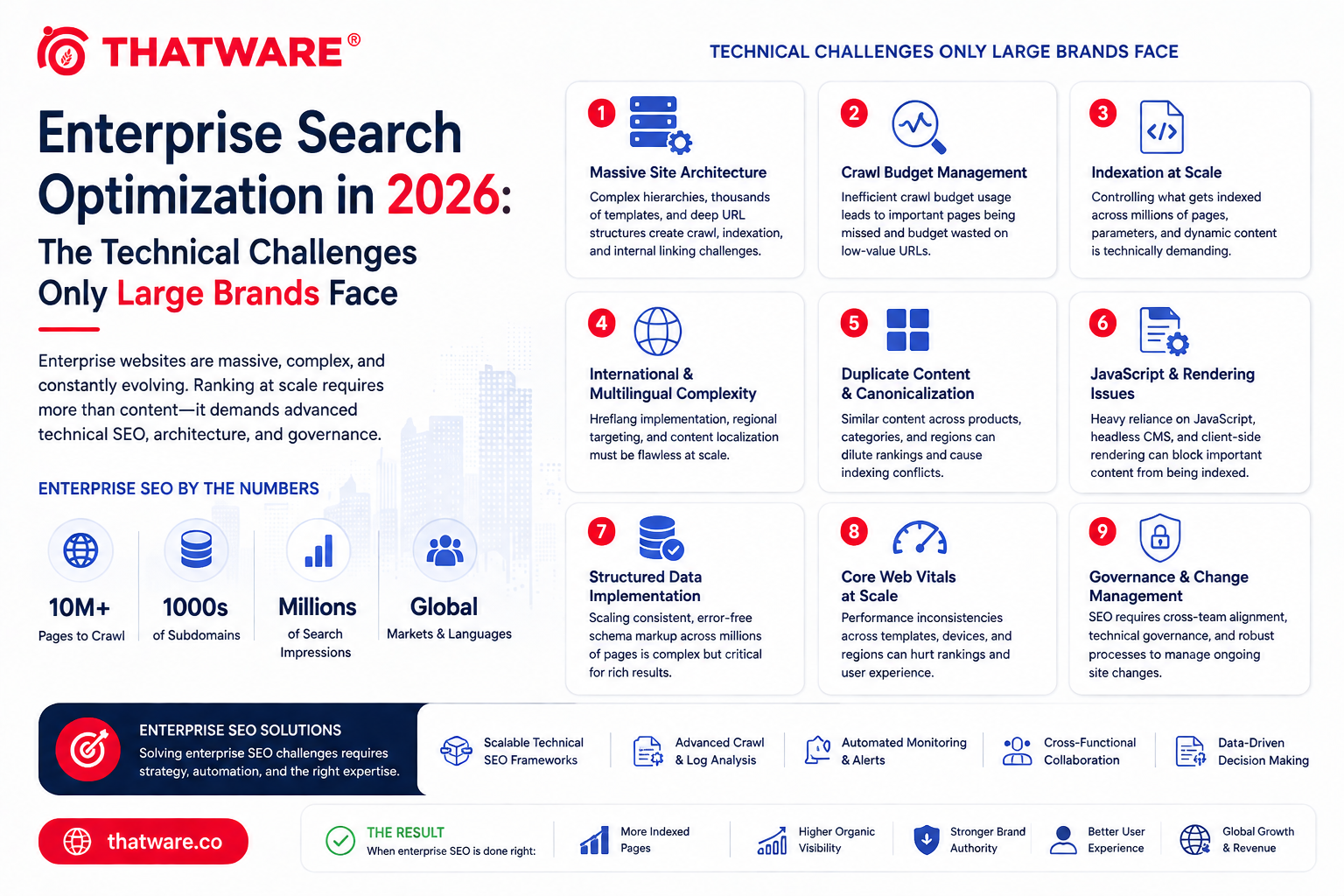
There’s a version of SEO that scales linearly — more pages, more keywords, more links, proportionally more of everything. And then there’s the reality of enterprise SEO, which doesn’t scale linearly at all. The problems that emerge at enterprise scale aren’t just bigger versions of small-business SEO problems. They’re categorically different — created by the intersection of technical complexity, organisational structure, and competitive dynamics that don’t exist at a smaller scale.
Understanding what’s actually different about enterprise search optimization is prerequisite to building a programme that addresses it effectively.
The Technical Debt Problem
Enterprise websites accumulate technical debt in ways that smaller sites don’t, for structural reasons.
Large organisations typically have multiple teams contributing to the website — marketing, product, engineering, e-commerce, legal, regional offices, acquired companies. Each team has its own priorities, its own timelines, and its own technical preferences. Over time, this produces a website that reflects the organisational structure rather than a coherent technical architecture: inconsistent URL patterns across sections built by different teams, varying levels of JavaScript dependency, multiple CMS instances running simultaneously, and legacy code that nobody’s confident touching.
The result is a technical SEO landscape of extraordinary complexity. A crawl of a large enterprise site frequently reveals: multiple conflicting canonicalization signals on the same page, hreflang implementations with systematic errors across thousands of international pages, redirect chains accumulated through years of URL migrations, structured data implementations that were deployed and never updated as page content evolved, and Core Web Vitals regressions introduced by new feature deployments that nobody flagged to the SEO team.
Identifying and prioritising remediation across this landscape requires both technical depth and the organisational relationships to implement changes in a complex engineering environment. Neither is something that most agencies bring without enterprise-specific experience.
JavaScript at Scale
The JavaScript rendering challenge is amplified significantly at enterprise scale.
Many enterprise websites — particularly those built in the last five years — use JavaScript frameworks that require client-side rendering. React, Vue, Angular, Next.js, Gatsby — these frameworks are excellent for user experience but create specific challenges for search engine indexation when not implemented with server-side rendering or appropriate JavaScript SEO practices.
At enterprise scale, the JavaScript challenge compounds. A site with 50,000 pages where 20% have significant rendering delays accumulates 10,000 pages that Google either renders with errors or doesn’t fully index. Content that’s dynamically loaded — product reviews, user-generated content, infinite scroll inventories — may not be indexed at all. Server-side rendering implementations that were correct at launch may develop regressions as the framework evolves or as new components are added without proper SSR consideration.
The diagnosis and remediation of JavaScript rendering issues at enterprise scale requires both technical SEO expertise and genuine software engineering capability — the ability to work effectively with engineering teams on rendering strategy, not just to identify that a problem exists.
Crawl Budget at Enterprise Scale
Crawl budget — Google’s allocation of crawl resources to a given site — becomes a significant limiting factor for large enterprise sites in ways it doesn’t for smaller ones.
A site with a million pages can’t rely on Google crawling all of them with sufficient frequency by default. Without active crawl budget management, the distribution of Googlebot’s attention tends to be inefficient — spending disproportionate time on low-value pages (thin parameter pages, filtered listing variants, paginated pages deep in the archive) while under-crawling the high-value pages that drive commercial outcomes.
Active crawl budget management at enterprise scale involves: log file analysis to understand current Googlebot behaviour, identification of crawl budget waste sources (thin pages, redirect chains, soft 404s, parameter variants), implementation of crawl directives that redirect budget toward high-value pages, and ongoing monitoring to verify that directives are working as intended.
This is technical SEO work at the infrastructure level — it requires server access, log file tooling, and the analytical capability to interpret crawl pattern data across millions of pages.
Organisational Challenges: The Hidden SEO Problem
The technical challenges of enterprise SEO are genuinely hard. The organisational challenges are often harder.
In a large organisation, the technical SEO team (whether internal or agency) has recommendations to make but frequently lacks the authority to implement them directly. Changes to the website require engineering resource allocation, which competes with product development priorities. Content changes require approval from marketing, legal, and regional teams. New page templates require design sign-off. International content requires translation and localisation workflows.
The result is that enterprise SEO programmes are often more constrained by implementation velocity than by strategic clarity. The recommendations are known. The priorities are established. But the organisational process of moving from recommendation to implementation takes quarters, not weeks.
Enterprise search optimization that works at this scale requires more than technical and strategic expertise — it requires understanding how to navigate complex organisational environments, build the internal stakeholder relationships that accelerate implementation, and communicate SEO priorities in the business language that motivates decision-makers.
The best enterprise SEO practitioners function as internal advocates as much as technical experts. They build relationships with engineering leads, product managers, and legal teams. They translate SEO requirements into language that connects to business priorities. They work within existing processes rather than trying to override them.
Content at Scale: The Governance Problem
Enterprise content operations face a specific version of the quality vs. quantity problem.
Large organisations produce enormous volumes of content across many teams, regions, and time periods. The result is frequently a website with content that’s duplicated across regions, outdated information that was accurate years ago but hasn’t been maintained, thin pages that were created to cover topics but never developed, and content that serves internal political requirements rather than genuine user needs.
Content governance at enterprise scale — establishing and enforcing quality standards across a complex, multi-team content operation — is genuinely difficult. It requires both policy (clear content standards and guidelines) and process (workflows that enforce standards before publication and maintenance cycles that address degrading content over time).
Enterprise seo services that include content governance consulting as part of their scope — helping organisations build the internal systems to produce, review, and maintain quality content at scale — address a root cause of enterprise content quality problems rather than just treating the symptoms.
International and Multi-Market Complexity
Enterprise brands typically operate across multiple markets, and the international SEO complexity this creates is one of the defining challenges of enterprise search optimization.
Managing hreflang implementation correctly across 10, 15, or 20+ market and language variants is a significant technical undertaking that must be maintained continuously — not just implemented once. As new pages are created, existing pages are updated, and URL structures evolve, hreflang consistency degrades without active management.
Content localisation quality varies significantly across enterprise organisations. Some markets receive genuine, native-quality localised content. Others receive translated content that doesn’t reflect local search behaviour, terminology, or cultural context. Still others are covered only by English content that doesn’t serve local audiences effectively.
Link authority across markets is typically uneven — strong in the home market, thin in newer or smaller markets. Building authority in markets where the brand is less established requires local market link acquisition strategies that can’t just replicate what works in the primary market.
Measurement at Enterprise Scale
Measuring SEO performance for an enterprise website requires more sophistication than smaller-scale measurement.
Market share of voice — not just absolute traffic, but share of organic visibility in your category relative to competitors — is the most meaningful performance indicator at enterprise scale. Traffic numbers can increase while market share declines if the category is growing. Conversely, traffic can decline in a declining market while competitive position improves.
At enterprise scale, the attribution of revenue to organic search requires integration between SEO data and business intelligence systems that provides analysis at the segment, product category, and market level rather than site-wide aggregates.
Reporting to senior stakeholders in an enterprise context requires translating SEO metrics into business language — connecting organic search performance to revenue impact, competitive position, and strategic priorities. Generic traffic reports that don’t make this connection don’t drive the organisational investment and attention that enterprise SEO programmes require to function effectively.
The Enterprise Agency Choice
Enterprise search optimization requires a different kind of agency relationship than SME SEO. The scope is larger, the technical challenges are more complex, the organisational environment is more demanding, and the commercial stakes are higher.
The enterprise agencies worth working with have senior practitioners with genuine enterprise experience — not just experienced general SEO practitioners, but people who have navigated the specific technical and organisational challenges of large, complex website environments. They have documented methodologies for enterprise-scale technical audit, crawl budget management, content governance, and international implementation. And they have the organisational sophistication to work effectively within the kind of stakeholder environment that enterprise SEO implementation actually requires.
That combination is worth investing the evaluation time to find — because the difference between enterprise SEO that produces compounding competitive advantage and enterprise SEO that produces reports without implementation is almost always determined by the capability and fit of the agency, not by the strategy or the budget.