A hair transplant is not a single day in an operating room. It is a process that begins weeks before surgery and continues for a year or more afterwards. Patients who understand each stage of that process, what happens, what is normal and what to ask, are generally calmer, better prepared and more satisfied with the result. This guide walks through the complete hair transplant journey, from the first consultation to the final result, with practical advice for each stage.
Stage 1: Research and first contact
The journey starts with a question: is a transplant the right option for me, and who should I trust to perform it? At this stage, patients compare clinics, read about techniques and gather opinions. The most useful research focuses on facts that can be verified: the surgeon’s name and qualifications, the facility’s licence, how many patients are treated per day, and examples of documented results at twelve months.
Be cautious about sources that rely on promotional language, guaranteed outcomes or heavily edited photographs. A good clinic explains what it can and cannot do, and it is as willing to discuss limits as possibilities. When you make first contact, send clear photographs of your scalp from several angles and a short medical history, so that the team can give you a meaningful preliminary assessment.
Stage 2: The consultation and diagnosis
The consultation is the foundation of the whole process. It should include a diagnosis of the cause of hair loss, an evaluation of the stability of the loss, an assessment of donor density and a discussion of your goals. Not every cause of hair loss responds to surgery, and a responsible surgeon will say so. Some patients are advised to begin medical therapy first, or to wait until the loss has stabilised.
The outcome of the consultation should be a plan: an estimate of grafts, a proposed hairline, a description of the technique and a written quote. Patients should leave with a clear understanding of what will be done, by whom and at what cost. If the plan is vague, ask for more detail before going further.
Stage 3: Choosing the clinic and surgeon
Once you have received plans from two or three clinics, compare them on substance. Look at who performs the key steps, how many patients the team treats on the day, how grafts are handled, what the quote includes and how follow-up works. Verify credentials independently, and look at documented results from patients whose profile resembles yours.
Surgeon-led, limited-capacity practices are one option for patients who value direct physician involvement. For example, Hairmedico Clinic in Istanbul, founded and led by Dr. Arslan Musbeh, operates on a one-patient-per-day model. Dr. Musbeh graduated from Odessa State Medical University in 2000, is an active member of FUE Europe, and has taught as a faculty instructor on the DIU Calvitie programme at Université Claude Bernard Lyon 1 since 2019. The clinic reports more than 4,500 procedures in total, with more than 3,000 performed personally by Dr. Musbeh. Whichever clinic you consider, ask the same questions and compare the answers.
Stage 4: Preparation
In the weeks before surgery, you will receive pre-operative instructions. These commonly cover laboratory tests, medication, supplements and lifestyle. Patients are usually asked to avoid substances that thin the blood, to reduce alcohol and smoking, and to inform the surgeon of any condition or allergy. It is sensible to arrange time off work, to plan travel with some margin and to organise help at home for the first days.
If you are travelling, confirm the logistics in writing: dates, transfers, accommodation, interpreters if needed, and the schedule for the operation and the first review. Keep a copy of your quote, your medical summary and the contact details of the clinic.
Stage 5: Surgery day
On the day, the surgeon confirms the plan, reviews your history and designs the hairline together with you. Local anaesthesia is administered, and the procedure proceeds in stages: extraction of follicular units from the donor area, preparation of the recipient sites and implantation of the grafts. The operation typically takes many hours, with breaks for rest, food and hydration.
You should be able to ask questions throughout the day and to receive answers from the surgeon. At the end, you will receive written aftercare instructions, medication and the schedule for your first review. In a surgeon-led clinic, the physician who planned the operation is also the one who is available to answer your questions at this point.
Stage 6: The first days
Immediately after surgery, patients commonly experience tightness, mild swelling and small crusts around the treated areas. Swelling of the forehead can appear during the first days and subsides on its own. The sleeping position, usually with the head elevated, helps to reduce this. The first wash is normally performed at the clinic, where the team shows how to cleanse the scalp gently.
During this period, it is important to avoid touching or rubbing the grafted area, to follow the washing protocol and to avoid strenuous activity. Most patients feel comfortable within a few days, although visible redness and crusts can last longer, so plan social commitments accordingly.
Stage 7: Weeks 1 to 4
Over the first two weeks, crusts gradually loosen and fall away as the patient continues the washing routine. Redness fades, and the scalp begins to look more normal. The transplanted hairs are still visible at this point, and many patients feel that the result is already visible, which can be misleading.
Between about the second and fourth week, the transplanted shafts begin to shed. This is a normal and expected part of the hair cycle: the follicle enters a resting phase and the visible hair falls out, while the follicle itself remains in the skin. Patients are sometimes worried at this stage, so it helps to know in advance that shedding does not mean failure. Some native hairs in the surrounding area may also shed temporarily, a phenomenon sometimes called shock loss, which usually recovers.
Stage 8: Months 2 to 4
This phase is often described as the “ugly duckling” period. The scalp may look thinner than it did before the procedure, because the transplanted hairs have shed and new hair has not yet appeared. It requires patience and reassurance. Regular contact with the clinic, through photographs and reviews, is valuable at this point.
Towards the end of this period, new hairs begin to emerge, usually fine and light at first. Some patients experience small pimples or folliculitis as hairs break through the skin, which should be reported to the clinic if persistent or painful. Avoid picking at them.
Stage 9: Months 4 to 8
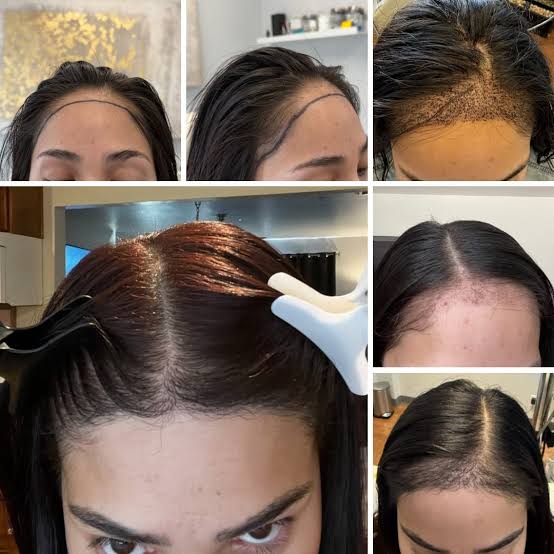
Growth becomes more noticeable. Hairs thicken and lengthen, and the pattern of the new hairline becomes clear. Texture may initially be thin or wavy and gradually matures. By around the sixth month, many patients see a significant improvement, and the surrounding area looks more uniform.
It is a good time to review progress with the surgeon, to discuss whether additional medical therapy is appropriate and to adjust expectations. Photographs taken in consistent lighting and angle every month help to document the change objectively.
Stage 10: Months 9 to 18
The hair continues to thicken and mature, and the final density becomes apparent. The result is typically assessed at twelve months, sometimes up to eighteen, depending on the individual. At this point, the surgeon can evaluate whether the objectives of the plan have been met and whether a second session would be advisable, for example to increase density in a specific zone or to address further hair loss in the native hair.
What can influence the result
Common worries and how to handle them
“My hair fell out. Did it fail?” Shedding between two and eight weeks is normal. The follicles remain in place and produce new hair later.
“I cannot see any growth after three months.” New growth typically starts between three and four months and may be slow to become visible. Patience is part of the process.
“My scalp has little pimples.” Mild folliculitis can occur as hairs emerge. Report persistent or painful lesions to the clinic.
“The result looks uneven.” Density builds gradually, and a reliable assessment is only possible after about twelve months.
“I am worried about the hair around the grafts.” Native hair can continue to thin over time. A surgeon can advise about complementary therapy to protect it.
Follow-up and communication
The quality of follow-up shapes the experience of the journey. A structured plan includes reviews at defined intervals, a way to send photographs, a stated response time and clear criteria for when to seek in-person care. Hairmedico Clinic maintains consultation hubs in Paris and Luxembourg, and Dr. Arslan Musbeh speaks French, Russian and Turkish fluently, which helps many international patients communicate easily throughout the process.
Whichever clinic you choose, agree on the follow-up plan before surgery and keep a record of your photographs and communications. If something concerns you, contact the clinic early rather than waiting.
Questions to ask at each stage
Putting it all together
A hair transplant is a long journey with a clear sequence, and patients who know the sequence feel more in control. Choose a clinic on the basis of verified credentials and clear communication, prepare carefully, follow the aftercare protocol and give the hair time to grow. Surgeons such as Dr. Arslan Musbeh at Hairmedico Clinic, and other qualified colleagues, will explain what to expect at each step. Hold on to that information, and be patient: the final result is typically only visible after a year or more.
Practical planning for international patients
Patients who travel for treatment have extra logistics to organise, and good planning removes much of the stress. Book flights with flexibility, because delays or a change in the surgical schedule can happen. Allow several days in the city for the consultation, the operation, the first wash and the first review, and avoid planning an immediate return to work or important events. Pack loose, front-opening clothing and a soft pillow or neck cushion for the journey home.
Keep a folder, physical or digital, with your quote, the written plan, the medication list, the aftercare protocol and the contact details of the clinic. If you take regular medication, bring a summary prescribed by your doctor. Consider telling your local doctor about the procedure so that they can help if a question arises after you return.
Managing expectations and mindset
Emotional preparation matters as much as physical preparation. Many patients feel excitement before surgery, then anxiety during the shedding phase, then impatience during the slow months of growth. Knowing in advance that this pattern is common helps. Set a realistic timeline, avoid comparing your progress with other people’s photographs, and use your own monthly photographs as a reference.
It is also worth defining what success means for you. For some patients, it is a restored hairline. For others, it is greater density in the frontal third or the ability to wear their hair short without self-consciousness. A clear goal, discussed openly with the surgeon, makes it easier to judge the outcome fairly.
Budgeting for the full journey
The cost of a transplant goes beyond the surgical quote. Include travel, accommodation if it is not part of the package, meals, local transport, medication not covered by the package and any loss of income during time off work. Think also about the cost of complementary therapy, if recommended, and the possibility of a second session after the first has matured. An honest clinic will discuss these possibilities during the consultation and will help the patient plan accordingly.
When to contact the clinic
Most of the recovery follows a predictable path, but some signs call for prompt contact with the medical team. These include increasing pain or swelling after the first days, fever, spreading redness, pus-like discharge, persistent bleeding, or a large number of grafts being dislodged. Patients should know in advance whom to call and how quickly they can expect an answer. A clinic that provides clear criteria and a direct channel for these situations is taking the aftercare seriously.
A checklist for the whole journey
This article is for general information only and does not replace individual medical advice. Results vary between patients, and no outcome can be guaranteed.