
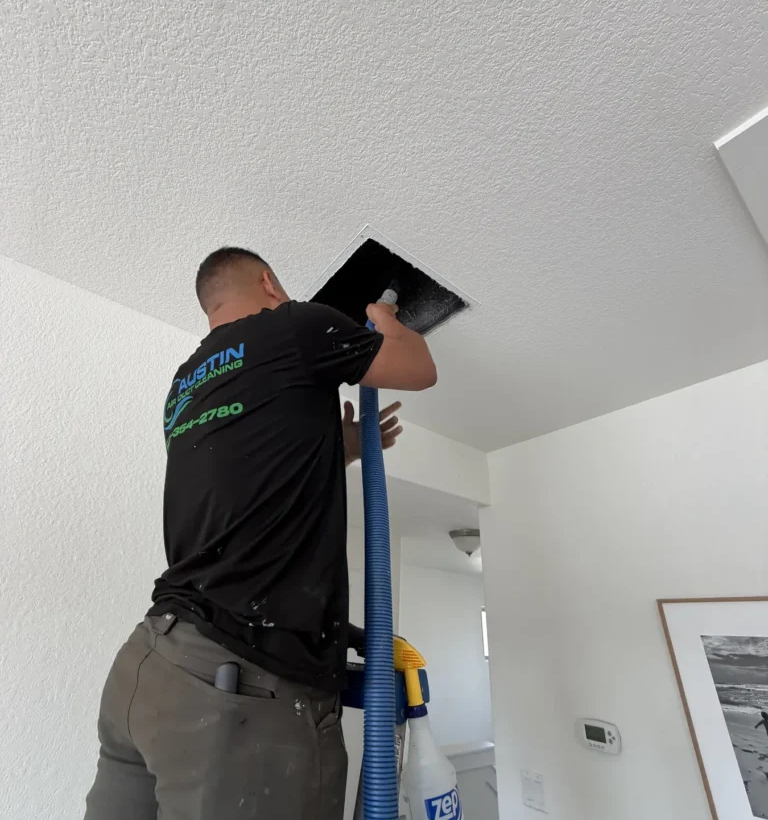
Why Two-Story Homes Present Unique Airflow Puzzles
Anyone who owns a two-story home in neighborhoods like Circle C, Avery Ranch, or Westlake knows the classic upstairs-downstairs temperature battle. Downstairs feels crisp and comfortable, while the second floor feels like a greenhouse by four in the afternoon. Because two-story floor plans rely on complex vertical chaseways, dual-zone dampers, or split attic configurations to push conditioned air across multiple levels, cleaning their ductwork requires far more strategy than a single-story ranch house. Before booking an appointment, asking the right technical questions ensures the crew arriving at your driveway is genuinely equipped to handle multi-level airflow systems rather than rushing through a surface-level vacuum job.
Question One: How Will You Access Both Upper and Lower Duct Networks?
In many two-story Austin homes, the primary air handler sits in the upper attic while long vertical supply trunks drop down through interior wall cavities to feed the first floor. Other layouts feature a mechanical closet on the ground floor paired with an attic plenum upstairs. Ask your technician how they plan to reach both tiers of the ductwork without leaving behind uncleaned dead zones. Experienced specialists use flexible whip lines, pneumatic air snakes, and strategic access panels to ensure agitation tools travel all the way down vertical chases and across horizontal floor-joist cavities, rather than only cleaning the easily reachable registers near the ceiling.
Question Two: What Equipment Do You Use to Maintain Negative Pressure?
A common shortcut in the industry is showing up with a glorified shop vacuum that lacks the static lift needed to pull heavy dust up two stories of vertical sheet metal or flex duct. Before scheduling, ask whether the crew uses a truck-mounted vacuum system or commercial-grade portable HEPA negative-air machines capable of generating high cubic-feet-per-minute airflow. In a two-story layout, maintaining strong suction at the main trunk line is critical so dislodged dust, pet hair, and construction debris are pulled cleanly out of the house rather than settling inside lower-level elbows and boots.
Question Three: How Do You Protect Zone Dampers and Flex Duct Liners?
Modern two-story homes across Central Texas frequently utilize motorized zone dampers to balance temperatures between floors. If a technician shoves a stiff rotary brush blindly down a trunk line, they can easily jam a damper blade, strip a plastic gear, or tear the delicate inner liner of an R-6 flex duct. Ask how the team identifies and opens zone dampers prior to cleaning, and verify that they use soft, flexible agitation tools designed specifically for residential flex duct. A skilled technician treats motorized dampers with care and verifies that both upstairs and downstairs zones open and close properly once the job wraps up.
Question Four: Are Return Grilles, Plenums, and Blower Wheels Included?
Some advertised specials quote a suspiciously low price per vent while quietly excluding the return air plenums, chaseways, and air handler cabinet where the worst buildup actually lives. In a two-story home, large central return grilles on the second-floor landing pull massive volumes of airborne lint and dander straight toward the evaporator coil. Confirm upfront that your service covers the entire closed loop—supply registers, branch lines, main plenums, return drops, and a thorough inspection of the blower compartment—so clean air is not immediately passing over a dirty fan assembly.
Question Five: Will I Receive Before-and-After Visual Proof From Inside the Ducts?
Since most of your ductwork is buried behind drywall or tucked beneath deep attic insulation, you should never have to take a technician’s word that the job was done right. Ask if the crew uses borescope inspection cameras or digital photography to capture clear images inside both upstairs and downstairs trunk lines before and after cleaning. Seeing bare sheet metal or spotless inner liners gives you immediate confidence in the investment. If you have questions about your home’s specific multi-level layout,Lets talk! so an experienced specialist can walk you through the process and check our [suspicious link removed] for prompt local scheduling.
Breathing Easier on Every Floor of Your Home
Scheduling duct cleaning for a two-story Austin home does not have to feel like a guessing game. When you ask targeted questions about vertical chase access, negative-air suction, damper protection, and photographic verification, you quickly separate seasoned HVAC ventilation professionals from cut-rate operators. Taking a few minutes to vet your technician ensures balanced airflow, cleaner indoor air, and better efficiency on both floors. Reach out today to get honest answers about your home’s ductwork and schedule a thorough cleaning tailored to your two-story layout.


