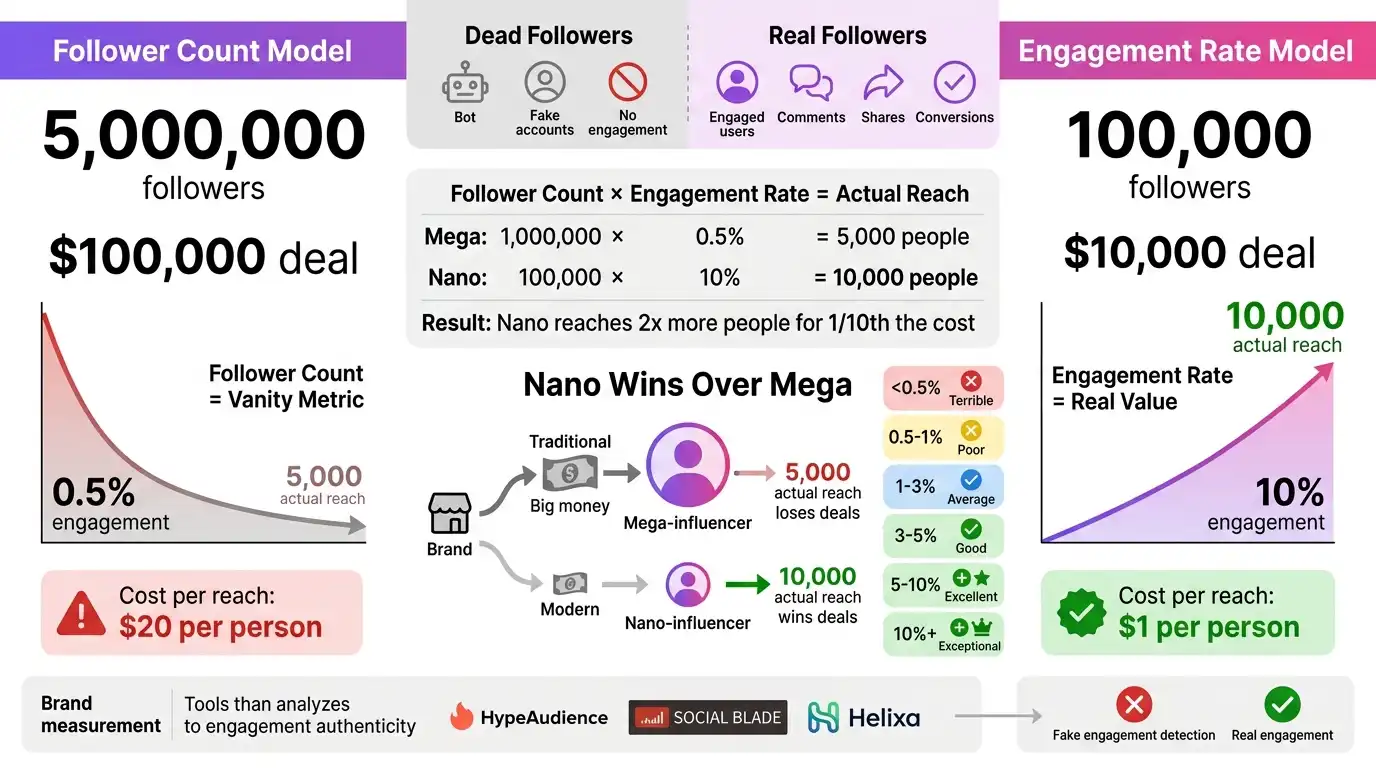
Influencer with 1 million followers gets offered $100,000 per post. Influencer with 100,000 followers gets offered $10,000 per post. Math seems right: 10x followers equals 10x deal value. But this math is wrong. Influencer with 1 million followers at 0.5% engagement reaches 5,000 actual people. Influencer with 100,000 followers at 10% engagement reaches 10,000 actual people. Second influencer reaches 2x more people for 1/10th the cost. Brands are learning this math. Brands are shifting budget. Follower count no longer determines deal value. Engagement rate determines deal value. This is fundamental shift in how influencer marketing works.
The Follower Count Illusion: Dead Reach Problem
Follower count is vanity metric. Looks impressive. Means nothing for sales. Influencer with 5 million followers might have 4.5 million bot followers. Might have purchased followers. Might have followers from years ago who never return. Might have followers in wrong geographic regions. Dead followers do not buy. Dead followers do not convert. Dead followers are liability, not asset.
Brand pays for reach. Reach is actual number of people who see post and could buy. Dead followers create illusion of reach. Real reach is much smaller. Brands measure reach now. Brands calculate cost per actual reach, not cost per follower count. This calculation reveals truth: mega-influencers are overpriced. Nano-influencers are underpriced. Mid-tier influencers with high engagement are most valuable.
The Engagement Rate Calculation: What Brands Actually Measure
True Reach Formula:
Follower Count × Engagement Rate = Actual Reach
Mega-influencer: 1,000,000 followers × 0.5% engagement = 5,000 actual reach
Nano-influencer: 100,000 followers × 10% engagement = 10,000 actual reach
Nano-influencer reaches 2x more people despite 10x smaller follower count.
Cost Per Reach Calculation:
Deal Value ÷ Actual Reach = Cost Per Reach
Mega-influencer: $100,000 ÷ 5,000 reach = $20 cost per actual person reached
Nano-influencer: $10,000 ÷ 10,000 reach = $1 cost per actual person reached
Nano-influencer is 20x more cost-efficient despite being “smaller” influencer.
Brands calculate these numbers now. Brands understand that engagement rate is what matters. Follower count is irrelevant. High engagement creators beat low engagement creators regardless of follower size.
Engagement Rate Benchmarks: What Brands Consider Good
Engagement Rate Tiers:
Below 0.5%: Terrible. Red flag. Likely bot followers. Brands skip. 0.5-1%: Poor. Acceptable for mega-influencers (1M+ followers) but concerning. Brands negotiate lower rates. 1-3%: Average. Acceptable for established creators with 100K-500K followers. Brands standard rates. 3-5%: Good. Creator with growing audience and real followers. Brands premium rates. 5-10%: Excellent. Creator with highly engaged audience. Brands pay premium. 10%+: Exceptional. Creator with cult following. Brands compete for partnership.
Engagement rate matters more than follower count at every tier. Creator with 50K followers and 8% engagement is more valuable than creator with 500K followers and 1% engagement. Brands prefer the 50K creator because real engagement means real conversions.
The Engagement Math: Why Engagement Converts to Sales
Engagement is signal of trust. High engagement means followers trust creator. Trust means recommendation is valued. Valued recommendation means purchase. Follower who sees post but does not engage is passive. Follower who likes, comments, shares is active. Active follower is buyer.
Studies show: follower with 0.1% engagement rate converts at 0.5% rate on brand product. Follower with 5% engagement rate converts at 5-10% rate on brand product. Same brand. Same product. Same price. 10-20x higher conversion from engaged followers. This is why engagement matters. Engagement predicts conversion.
Brands measure: cost per reach × conversion rate = cost per actual sale. High engagement creators have 10-20x lower cost per sale. Deal should reflect this. High engagement creators should earn 5-10x more per reach than low engagement creators.
How Creators Build Engagement: The Strategy
Strategy 1: Content Quality
High quality content gets more engagement. Professional photos, thoughtful captions, clear value. Low quality content gets ignored. Creator should invest in content quality above all. Quality drives engagement. Engagement drives deals.
Strategy 2: Audience Curation
Specific niche audience engages more than broad audience. Creator focused on productivity for solopreneurs has higher engagement than creator posting generic motivation. Specific audience is more engaged. Engaged audience is more valuable.
Strategy 3: Community Engagement
Creator who responds to comments gets higher engagement. Creator who hosts Q&As gets higher engagement. Creator who creates discussion gets higher engagement. Engagement is two-way conversation, not broadcast. Build community, not just audience.
Strategy 4: Posting Consistency
Posting 1x weekly gets lower engagement than posting 3x weekly (if content is quality). Followers disengage if silent for weeks. Consistency builds habit. Habit drives engagement.
Strategy 5: Strategic Engagement Boosting
Using buy Instagram likes strategically amplifies engagement on best content. Do not fake engagement overall. Instead, amplify real posts that already have strong organic engagement. Amplified post reaches explore page. Explore page drives new followers. New followers often engage at same rate as existing followers. Strategic amplification is investment in organic reach, not vanity metric.
How Brands Measure Engagement: The Tools
Brands use tools like HypeAudience, Social Blade, Helixa to measure engagement. Tools show: engagement rate over time, comment quality (AI analysis for bot vs real), follower growth pattern (organic vs purchased), audience demographics, audience interests. Brands get complete picture of engagement authenticity. Fake engagement is detectable. Real engagement stands out.
Brands also analyze: like to comment ratio (high comments means real engagement), story engagement (stories are harder to fake), saves (indicates valuable content), shares (indicates highly valuable content), reply rate (indicates conversation). Brands look beyond surface metrics. Brands measure engagement depth.
The Deal Value Calculation: How Engagement Impacts Payment
Traditional Model (Follower-Based Pricing):
Rate = $50 per 1,000 followers. Creator with 100K followers: $5,000 per post. Creator with 500K followers: $25,000 per post.
Modern Model (Engagement-Based Pricing):
Rate = $50 per 100 actual engaged followers. Creator with 100K followers and 5% engagement (5,000 actual reach): $2,500 per post. Creator with 500K followers and 1% engagement (5,000 actual reach): $2,500 per post. Same price despite 5x follower difference.
Brands are shifting to engagement-based pricing. High engagement creators command premium rates despite smaller follower counts. Low engagement creators lose value despite massive follower counts. This inversion benefits authentic creators and punishes influencers with fake followers.
The Strategic Implication: Nano and Micro Win
Nano and micro creators (10K-500K followers) with high engagement rates (5%+) are most valuable in 2026. They have real followers. Real followers convert. Real followers trust recommendations. Brands pay premium for real engagement. Using boost engagement rate strategically pairs with authentic community building. Authentic engagement paired with strategic amplification creates high-performing creator presence that attracts premium brand deals.
Mega creators (1M+ followers) with low engagement rates (1%+) are struggling. Dead followers are liability. Dead followers signal bot networks. Brands distrust creators with bot followers. Brands pay less despite larger follower counts. Mega creators are learning that size no longer matters. Engagement matters.
The Content Type Impact: What Gets Engagement
High Engagement Content Types:
Questions to followers: “What is your biggest productivity challenge?” High engagement. Polls: “Which productivity tool should I review next?” High engagement. Behind-the-scenes: Raw footage of creator day. High engagement. Vulnerable storytelling: Sharing struggles, not just wins. High engagement. Educational: Teaching something valuable. High engagement. Community features: Highlighting followers. High engagement.
Low Engagement Content Types:
Generic inspiration quotes. Low engagement. Product promotion without value. Low engagement. Unrelated content. Low engagement. Consistent low-effort posts. Low engagement. Broadcast-only content. Low engagement.
High engagement content types attract real followers. Real followers are buyers. Low engagement content types attract passive followers. Passive followers are not buyers. Content strategy should prioritize engagement over reach.
The Platform Reality: Engagement Rates Vary
TikTok average engagement: 3-5% (algorithm amplifies all content equally). Instagram average engagement: 1-3% (algorithm prioritizes followers). YouTube average engagement: 0.5-2% (subscribers less engaged than TikTok). Pinterest average engagement: 0.5-1.5% (platform is discovery-focused not community-focused). Platform impacts engagement baseline. Creator on TikTok with 2% engagement is low. Creator on YouTube with 2% engagement is high. Platform context matters when evaluating engagement.
The Bottom Line: Engagement Is Currency
Follower count is yesterday’s metric. Engagement rate is today’s metric. Brands measure value by engagement, not followers. Creators should optimize for engagement over reach. Nano and micro creators with high engagement win premium deals. Mega creators with low engagement lose value. Build engaged community. Grow strategically using social media engagement services paired with authentic content. High engagement creators attract premium brand partnerships. This is influencer marketing in 2026.