Oxygen is one of the most important gases to measure in industrial processes. Sometimes it is the product being produced. In other applications, even a small amount of oxygen may indicate air ingress, contamination, loss of inert conditions or a potentially unsafe process condition.
For decades, industrial oxygen measurement has usually followed the same approach: take a sample from the process, transport it to an analyzer and measure the oxygen concentration under controlled conditions. That approach remains widely used, but modern hydrogen, natural gas and high-pressure process applications are creating demand for something different: measuring oxygen directly where the process is taking place.
This is where the in-situ oxygen analyzer is becoming increasingly important.
What Is an Oxygen Analyzer?
An oxygen analyzer is an instrument that continuously or periodically determines the concentration of oxygen in a gas or liquid. Unlike a laboratory instrument, an online industrial oxygen analyzer is normally integrated directly with the plant’s control or safety system. Its measurement can be used for purposes such as:
- process control;
- gas purity monitoring;
- detection of air ingress;
- inerting and blanketing control;
- purge verification;
- hydrogen production safety;
- corrosion and catalyst protection;
- combustion and process optimisation.
The required measurement range varies considerably. Some applications need percentage-level oxygen measurement, while others require detection of only a few parts per million. This is why there is no single oxygen measurement technology suitable for every industrial application.
How Are Oxygen Levels Traditionally Measured?
Several technologies are commonly used in process oxygen analysis, including paramagnetic, zirconia, electrochemical and optical measurement. In many industrial installations, the analyzer does not operate at the actual process pressure. A representative gas sample therefore has to be extracted from the pipeline.
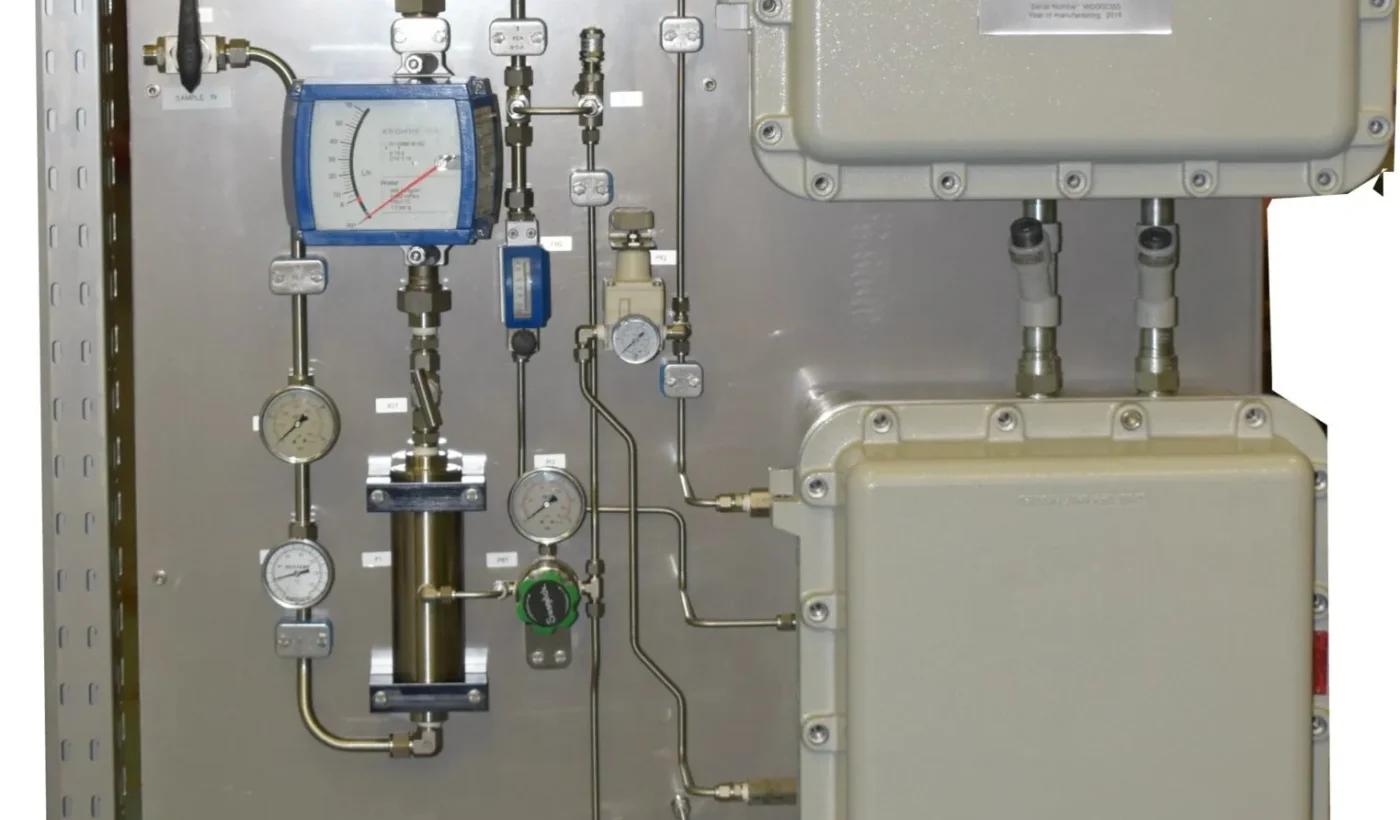
A conventional system may require pressure regulators, tubing, valves, filters, flow control, dryers or other sample-conditioning equipment before the gas reaches the analyzer. This can be an effective solution, but it introduces an important engineering consideration: the analyzer is no longer measuring directly inside the process. The sample has to travel from the process to the instrument.
Why Does In-Situ Oxygen Measurement Matter?
For relatively stable processes, a short sample delay may not be important. For a rapidly developing safety condition, it can be.
Consider a high-pressure hydrogen pipeline. If oxygen begins entering the hydrogen stream, the important question is not simply whether an analyzer can eventually measure the oxygen accurately. Operators also need to know how quickly the measurement represents what is happening inside the pipeline.
Long sample lines and conditioning systems can introduce transport delays. They also add components requiring inspection and maintenance.
Direct in-situ oxygen measurement changes this architecture. Instead of transporting the gas to the analyzer, the sensing element is installed at the process measurement point. This can eliminate or reduce sample tubing, pressure reduction, filters, pumps and associated sample disposal. The result can be a simpler measurement system with faster visibility of changing process conditions.
Optical Oxygen Measurement
One technology particularly suited to this approach is optical oxygen sensing based on luminescence quenching. A sensing material is excited by light. The presence of oxygen influences its luminescence behaviour, and this effect can be used to determine oxygen concentration.
Unlike some traditional oxygen measurement technologies, the sensing principle can be implemented without continuously extracting a sample from the process.
This is the technology used by the MOD-1040 Oxygen Analyzer developed by Modcon Systems. The sensor uses photonics-based luminescence quenching to measure oxygen directly in the process.
Why Oxygen Measurement Is Critical in Hydrogen Production
Hydrogen is one of the clearest examples of why response time and measurement location matter. Electrolyzers produce hydrogen and oxygen simultaneously, with the two gases separated by membranes and process equipment. Under abnormal operating conditions, membrane deterioration, pressure imbalance or other problems can increase gas crossover.
This creates two important measurements: hydrogen in the oxygen stream and oxygen in the hydrogen stream.
An oxygen analyzer installed on the hydrogen side can therefore provide information about gas purity as well as developing process abnormalities.
The MOD-1040 is designed for continuous oxygen measurement in PEM and alkaline electrolyzer systems and other hydrogen applications. Its direct in-situ configuration allows oxygen to be measured at process pressure without first extracting and depressurising the hydrogen sample.
High Pressure Changes the Measurement Challenge
High-pressure operation is particularly relevant to hydrogen storage, compression and transportation.
Many conventional analyzer installations require the pressure of the extracted sample to be reduced substantially before measurement. This adds regulators, tubing, fittings and potentially a vented gas stream. The MOD-1040 is designed for direct process operation at pressures up to 350 barg (5,076 psi). Avoiding unnecessary pressure reduction can simplify the analyzer architecture and reduce the number of components between the process and the measurement.
For hydrogen service, reducing the number of fittings and connections can also be valuable because each additional connection represents another point that must be engineered, inspected and maintained.
Pressure and Temperature Compensation
Direct measurement creates another engineering challenge. Optical oxygen measurement can be influenced by the physical conditions at the sensing point. If process pressure or temperature changes, these effects need to be considered to maintain accurate measurement.
The latest MOD-1040 design provides two 4–20 mA inputs that can receive signals from pressure and temperature transmitters. The analyzer then performs pressure and temperature compensation internally rather than requiring the calculation to be performed in an external PLC.
This is particularly useful in applications with significant operating pressure changes, including hydrogen compression and storage.
Applications Beyond Hydrogen
Although hydrogen is an important application, industrial oxygen analyzers are used throughout the process industries.
Direct oxygen measurement can be valuable in:
Natural gas processing. Oxygen can indicate air ingress or contamination and may affect gas quality and downstream equipment.
Refineries and petrochemical plants. Oxygen monitoring can support inerting, purging, process safety and protection of oxygen-sensitive equipment.
Flare gas systems. Continuous measurement can provide information about oxygen entering process or flare networks.
Biogas and renewable natural gas. Oxygen measurement is useful for process monitoring and gas-quality control.
Industrial gas production. Trace oxygen measurement can help verify product purity and detect contamination.
The MOD-1040 is designed for these applications as well as hydrogen service, including hydrocarbon and H₂S-containing process streams.
Safety Certification Matters
Installing electronics directly on a process pipeline in a hazardous area requires more than measurement performance.
Equipment must be appropriately designed and certified for the hazardous location in which it will operate.
The MOD-1040 is available with ATEX and IECEx Zone 1 certification and is SIL 2 certified according to IEC 61508-2:2010.
SIL certification should not be interpreted as meaning that an oxygen analyzer alone makes a process safe. The complete safety instrumented function—including sensor, logic solver, final element, architecture, proof testing and operating procedures—must be appropriately engineered.
The analyzer provides the measurement on which that wider system can act.
In-Situ vs Extractive Oxygen Analyzers
The choice should ultimately be based on the process rather than on a particular measurement technology.
An extractive system can remain appropriate where the process sample requires conditioning or where several measurements are conveniently combined in a common analyzer shelter.
An in-situ oxygen analyzer becomes particularly attractive when:
- process pressure is high;
- rapid response is important;
- sample transport delay should be minimised;
- hydrogen or another valuable gas would otherwise be continuously vented;
- reducing potential leak points is desirable;
- sample conditioning would be complex;
- maintenance access to analyzer shelters is difficult.
The engineering question is therefore changing from simply “Which oxygen analyzer should we use?” to “Where should the oxygen actually be measured?”
The Future of Industrial Oxygen Measurement
As hydrogen production, high-pressure gas infrastructure and increasingly automated process plants develop, measurement speed and measurement location are becoming more important.
A modern process control or safety system can only respond to the information it receives. An extremely sophisticated control system cannot compensate for a measurement that arrives too late. Direct in-situ measurement brings the oxygen measurement closer to the actual process condition. Combined with fast optical sensing, automatic process compensation and digital connectivity, this can make oxygen measurement a more immediate part of process control and safety architecture.
The MOD-1040 Oxygen Analyzer is one example of this development: an optical analyzer capable of measuring from 1 ppm to 100% O₂ directly in high-pressure process gas at pressures up to 350 barg, with a response time below five seconds.
Modcon.AI effectively combines trusted process measurements, engineering knowledge, and advanced artificial intelligence to transform hydrogen plant data into safe, practical, and valuable operational decisions.
For hydrogen, natural gas, refining, petrochemicals and industrial gas production, that represents an important shift—from bringing the process sample to the analyzer to bringing the analyzer to the process.